
Deadline Afterlife Processing Demo No Commentary: Station 9 Breakdown
The DEADLINE: Afterlife Processing demo no commentary gameplay showcases Station 9 where operators examine records, stamp verdicts, and route souls through diegetic audio cues. Watching the clean room audio highlights every gear turn, amber terminal readout, and pneumatic drop without voice interference.
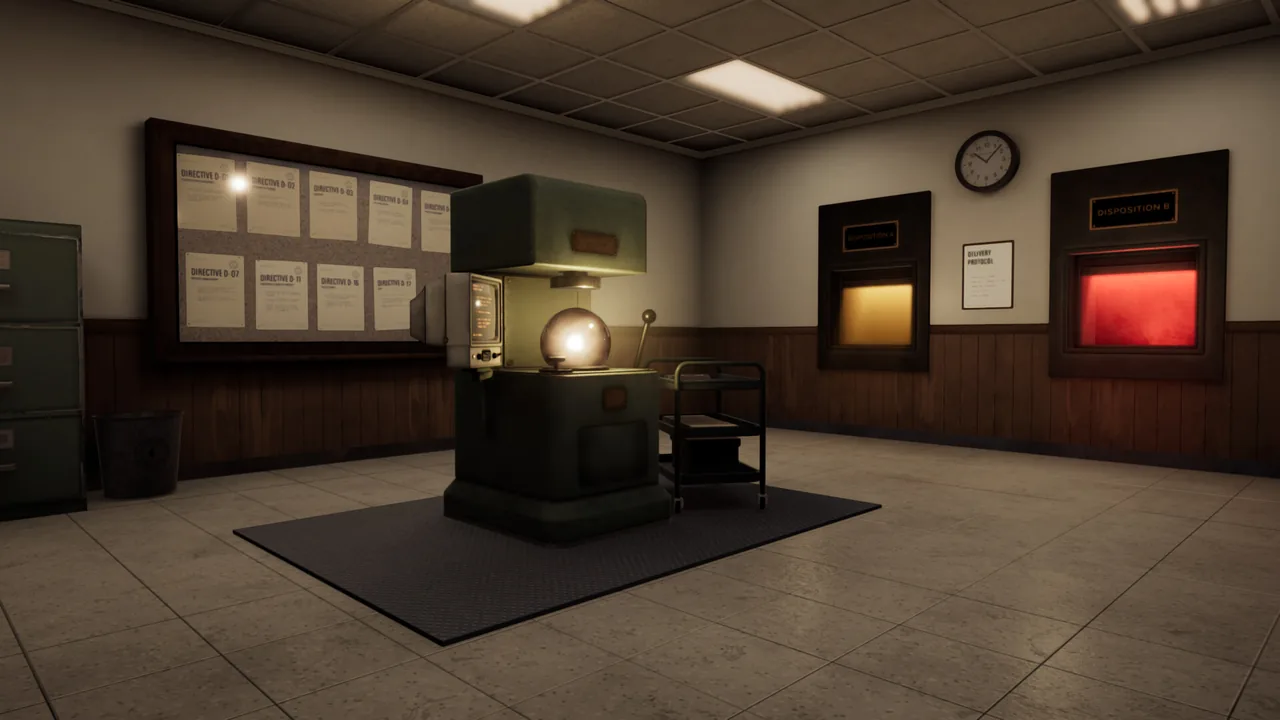
The DEADLINE: Afterlife Processing demo no commentary gameplay showcases Station 9 where operators examine records, stamp verdicts, and route souls through diegetic audio cues. Watching the clean room audio highlights every gear turn, amber terminal readout, and pneumatic drop without voice interference.
Station 9 Workstation Environment
The entire user interface in the MD Studio demo exists physically inside the work chamber. Players operate without health bars, minimaps, or floating HUD overlays. Information reaches the operator through paper slips, mechanical dials, and amber phosphor text displayed on an aging terminal.
Station 9 places the worker before a continuous line of waiting souls, depicted visually as abstract glowing spheres. Ambient sound provides critical feedback for each action. The heavy thud of the mechanical press, the hum of the amber terminal, and the click of the verdict toggles communicate the status of the current shift. Observing the workstation without commentary allows players to track these mechanical audio cues directly as paperwork moves across the desk.
Reading Soul Records and Issuing Verdicts
Soul evaluation depends on reading three distinct soul fragments printed across the terminal screen. The records contain brief, non-graphic descriptions of past lives, documenting actions such as theft, fraud, charity, or witness accounts:
- Read the amber terminal display to review alibis, confessions, and third-party statements.
- Cross-reference the documented actions against the rule board hanging beside the station.
- Select the correct destination based on active directives, such as sending theft to Descend or charity to Ascend.
- Pull the confirmation lever to bring down the heavy seal and convert the soul into paperwork.
- Carry the resulting document to the designated disposal exit: Disposition A (Gold) or Disposition B (Red).
Each processed soul outputs a paper slip that credits money to the worker account. When an ambiguous life history does not fit existing directives, the operator must make an executive choice, as management permits no appeals once paperwork drops into an exit chute.
Catalog Investments and Shift Upgrades
Earned wages allow operators to purchase equipment from the order window catalog. Upgrades alter the physical demands of Station 9 by speeding up line delivery, improving movement, or transferring manual sorting duties to machinery.
| Catalog Item | Workplace Role | Operational Advantage |
|---|---|---|
| Boot Upgrades | Movement across Station 9 floor | Increases walking pace between the press and exit chutes |
| Line Speed Units | Soul delivery queue | Accelerates intake frequency of waiting spirits at the window |
| Press Modifications | Physical stamping mechanism | Compresses and seals soul paperwork with fewer operator motions |
| Station automation | Mechanical task handling | Replaces repetitive sorting duties with dedicated machinery |
Investing earnings back into the workstation enables operators to keep pace with shifting directives and expanding rulebooks during longer shifts.
Technical Specifications for the Demo
The Steam build runs on Windows 10 64-bit systems through DirectX 12. MD Studio lists full controller support alongside native USB DualShock compatibility, allowing operators to run Station 9 using gamepads or standard mouse and keyboard controls.
- Minimum Processor: Intel Core i5-4460 or AMD equivalent
- Minimum Memory: 8 GB RAM
- Minimum Graphics: NVIDIA GeForce GTX 960 or AMD Radeon R9 280 (2 GB VRAM)
- Recommended Processor: Intel Core i5-8400 or AMD Ryzen 5 2600
- Recommended Memory: 16 GB RAM
- Recommended Graphics: NVIDIA GeForce GTX 1070, RTX 2060, or AMD Radeon RX 5700 (6 GB VRAM)
- Storage Requirement: 4 GB available space (SSD recommended)
The standalone demo lets players test workstation mechanics, text-driven moral choices, and diegetic soundscapes ahead of the planned Q1 2027 release window.